The government's food subsidy in the ongoing fiscal year is expected to be a little less than Rs 4 trillion.

'EV-charging is the next big opportunity after fuelling'

The government on Thursday said it will not allow prices of essential food items to increase due to the impact of possible deficient monsoon this year.

'This is the best time to do a pan-Indian film.'

For the Congress' revival, the eclipse of the Gandhis is absolutely necessary, asserts Virendra Kapoor.

'Just the fact that the biggest language at the box office was Telugu and not Hindi is startling.'
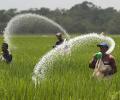
Enthused by rising potato prices after a prolonged slump, Pradeep Sharma was planning to sow the crop on his 15-acre farm near Agra slightly earlier than usual. The delayed departure of the southwest monsoon also prompted his decision, since the good soil moisture would have saved at least one initial irrigation. But the acute shortage of diammonium phosphate (DAP), a crucial nutrient ahead of the sowing season for potatoes, nipped those hopes in the bud. DAP is the second-most used fertiliser in the country after urea.

The report admits that converting MSP to a floor price of auction on the eNAM portal will not completely solve the problem as the current data shows that average modal prices in e-NAM mandis is lower than the minimum support price in all commodities except urad.

The new bill will now be introduced in the Lok Sabha for passage in the upcoming Winter session of Parliament beginning November 29.
Inflation in food articles during May stood at 1.13 per cent, as against 2.55 per cent in April.
The economic survey for 2020-21 has suggested revision in the weightage of food items to gauge the true picture of inflation in the country, and said new sources of price data also need to be incorporated in the wake of increasing retail e-commerce transactions. As per the survey, the current spike in consumer price-based retail inflation of food prices is mainly a supply-side phenomenon. The survey noted that the weights of all items in retail inflation are based on the NSO household consumption expenditure survey of 2011-12, adding the weight of food items in the index might have significantly decreased over the decade since then.

As the monsoon situation in India turns gloomy, relying on foreign markets for imports might not be of much help, since India is not alone in facing the spectre of a drought.

Days after their passage in the Lok Sabha, Tomar introduced the Farmer's Produce Trade and Commerce (Promotion and Facilitation) Bill, 2020, and the Farmers (Empowerment and Protection) Agreement of Price Assurance and Farm Services Bill, 2020 in the Rajya Sabha.

The farm sector has been resilient to the COVID-19 shock and is estimated to grow at 3.9 per cent this fiscal, the Economic Survey said on Monday, while suggesting to the government to give priority to crop diversification, allied farm sectors and alternative fertilisers like Nano urea. The Economic Survey 2021-22 also pitched for increasing agriculture research and development (R&D) and organic farming, besides use of new technologies like drones. "The performance of the agriculture and the allied sector has been resilient to the COVID-19 shock. ...Growth in allied sectors including livestock, dairying and fisheries has been the major drivers of overall growth in the sector," the Survey said. The agriculture sector has experienced buoyant growth in the past two years.
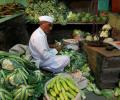
Inflation in onion continued to rule high at 42.22 per cent and in potato at 43.25 per cent.

The country's exports grew 5.37 per cent year-on-year to $27.24 billion in January 2021, mainly driven by healthy growth in pharma and engineering sectors, according to provisional data of the commerce ministry. Trade deficit during the month narrowed to $14.75 billion from $15.3 billion in January 2020. It was $15.44 billion in December 2020. Imports in January 2021 rose 2 per cent to $42 billion.

To tide over the difficulties due to incessant shutdowns, several farmers in Maharashtra have turned into aggregators and started selling their produce without the help of mandis or agents. They have started contracting with bulk consumers like hypermarkets and co-operative housing societies to sell their produce directly.

'With the largest number of malnourished people on the planet, India is poised to be a nation that significantly under-performs as an economy.'
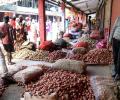
People in the know said plans were afoot to begin the sale of all food grains through online, with a major quantity through auctions that would be later extended to other commodities.
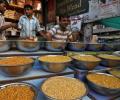
Retail tur dal prices on Monday shot up to Rs 200 per kg despite the government's steps to boost supply and check prices, aggravating consumers' woes.

The report, however, said it remains watchful of the upside risks to inflation emanating from pass-through of minimum support prices (MSPs), adverse movement in crude oil prices, volatility in global financial markets, lagged impact of the rupee weakness on input prices, adverse implications from fiscal slippage and staggered impact of HRA increases by states and its second-round impact.

'Only then will we withdraw the agitation.'
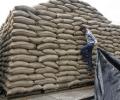
With grain procurement target significantly higher, FCI is faced with storage space shortage.
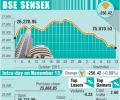
The 30-share Sensex closed lower by 256 points at 25,610.
The wholesale price-based inflation accelerated to a record high of 12.94 per cent in May, on rising prices of crude oil and manufactured goods. Low base effect also contributed to the spike in WPI inflation in May 2021. In May 2020, WPI inflation was at (-) 3.37 per cent. This is the fifth straight month of uptick seen in the wholesale price index (WPI)-based inflation. In April, 2021, WPI inflation hit double digit at 10.49 per cent. "The annual rate of inflation, based on monthly WPI, was 12.94 per cent for the month of May, 2021 (over May, 2020) as compared to (-) 3.37 per cent in May 2020.
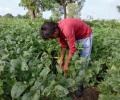
There has been some improvement in prices of oilseed and gram after the central government increased their import duties
The blame for the relentless ascent rests largely with the misguided agricultural marketing policies of the Centre and state governments.

Talks with government officials on VAT waiver fails.

Renault to launch MPV Lodgy to boost sale in India

'Interestingly in spite of slightly more than half (52%) the respondent farmers opposing the three new agri laws, almost 44% respondent farmers said the Modi government was 'pro-farmer'
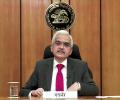
'There are some high-frequency indicators where uptick is visible and some where it is not'

Farmers should be encouraged into crops needing less of water, while ensuring a market for what they sow, said ICAR's head.

The agriculture minister said the government's constant efforts are aimed at making farmers prosperous by increasing their income.

India has raised tariffs on 28 items, including almond, pulses and walnut, exported from the US in retaliation to America's withdrawal of preferential access for Indian products.

'If these new farm laws are allowed to be implemented, there are very high chances of big increase in income of the farmers and in many states, it may even double'
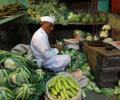
Build up inflation rate in the financial year so far was 2 per cent compared to a build up rate of 4.56 per cent in the corresponding period of the previous year. Inflation in food articles as a group rose to 11.08 per cent during the month as against 9.80 per cent in the previous month, mainly driven by exorbitantly high onion prices, the rates of which spiked by over 172 per cent from a year-ago. The annual rate of inflation, based on monthly wholesale price index was at 0.16 per cent in October.

'Why did government not include a provision in the bills which categorically stated that no crop will be sold below the MSP in the open market?'

State Bank of India's house economists on Monday said the recent farm sector reforms reek of parochial thinking and promote lazy farming as they only cater to cereal-producing states. In the recently concluded monsoon session, the government rushed through three legislation to change the way agricultural produce is marketed, sold and stored by dismantling the decades-old APMC (Agricultural Produce Market Committee) mandis.

As the COVID wave gradually shifts to rural areas, several states are gearing up to check its spread through self-proclaimed lockdowns by Panchayati Raj institutions, creating a database of migrants and providing free online medical consultation to the sick.

The President's assent to these bills comes amid the Opposition criticising the manner in which they were passed in Parliament.
